Showing posts with label painting. Show all posts

Wednesday, August 17, 2011

Bacon and eggs in Miller's Point Part 2

I finished my painting of the Harbour Control Tower by lunchtime. At last I was able to move my cramped, chilly limbs and choose a position for the afternoon painting where I could bask in the feeble winter sunlight.
The brickwork of the Argyle Cafe actually is quite dark, but it glows burnt orange as it was caught in the afternoon sun. The warmth contrasts beautifully with the deep green awnings and timberwork of the windows.


Painting the 'Argyle Cafe, late afternoon Millers Point'2011 oil on canvas 31 x 31cm
Enhanced by Zemanta

Monday, May 30, 2011

The Empty Wharf

Ghost Tower
The empty wharf' oil on canvas 25 x 51 cm 2009

It's finally happened.
Sydney Ports Corporation has moved out of the Sydney Harbour Control Tower at Barangaroo and into their spiffy new purple and silver premises at Port Botany.

The mushroom head of the tower now stands, isolated on the empty wharf, looming above the holes and piles of demolition rubble starting to accumulate around its base.
The construction workers and excavators appear like rats nibbling away here and there until the entire complex collapses.


There was no fanfare or publicity to mark the end of an era.

Only an eerie silence.

Saturday, November 27, 2010

My exhibition: "From the Hungry Mile to Barangaroo"


My exhibition: "From the Hungry Mile to Barangaroo"
Foyer of LendLease 30,'The Bond',
30 Hickson Road, Millers Point
Paintings of Barangaroo at Sydney Open - 30, The Bond

From left to right:
easel on left: 
top : 'Relics from the Dead House 2' 2007 oil on canvas 91 x 61 cm
bottom left: "Hungry Dinosaurs" 2010 oil on canvas 36 x 46 cm 
bottom right: "Grabber, Muncher,Ripper" 2010 oil on canvas 31 x 31cm

easel in centre: 
top: "I saw the number '8' in red"   2010 oil on canvas 61 x 183cm
centre: :"Red Square (Arrivals Hall) 2010 oil on canvas 61 x 183cm
bottom left: "The drill rig" 2010 oil on canvas 36 x 36cm
bottom right: "Red Square" 2010 oil on canvas 36 x 36cm

easel on right:

top left:"8 (ate)"  2010 oil on canvas 41 x 31cm
top right: "Dig it! (The archaeologists)"   2010 oil on canvas 31 x 15cm
centre: "A work in progress" 2010 oil on canvas 91 x 122cm (Unfinished)
bottom left: "The last gantry"  2010 oil on canvas 41 x 31cm
bottom right: "Pump it! (The 'Watertank')" 2010 oil on canvas 31 x 41cm


easel on left:
above: "The 'Southern Cross' (with Robbie and forklift)" 2010 oil on canvas 31 x 103 cm
centre : 'The working port' 2007 oil on canvas 100 x 122 cm

easel in centre: 
top left: "The tug "Karoo""   2008 oil on canvas 20 x 25cm
top right: :"The tug "Woona" 2008 oil on canvas 20 x 25cm
below: "The 'Tamerlane' after rain" 2005 oil on canvas 75 x 100cm

easel on right:
top :"2 cranes"  2006 oil on canvas 41 x 51cm
below: "Boat Lift"   2007 oil on canvas 100 x 122cm


 A small selection of my paintings of the East Darling Harbour Wharves and their transformation into the Barangaroo precinct were exhibited for one day only in the foyer of the LendLease Headquarters 30, The Bond directly opposite the Barangaroo site itself. Here they are displayed in front of the spectacular escarpment wall of yellowblock sandstone, catching the dying embers of the afternoon sun. 
On the same day a selection of my Pyrmont paintings were also exhibited in the foyer of 'Workplace6', headquarters of Google, and 2 of Paul Signorelli's new restaurants, 'Biaggio' and 'Gastronomia'.
I borrowed the "A" frame easels from John Sweaney of ASMA (The Australian Society of Marine Artists) and put my entire black ankle sock collection on their feet to prevent the floor being scratched!


easel on left:

top : 'Relics from the Dead House 2' 2007 oil on canvas 91 x 61 cm
bottom left: "Hungry Dinosaurs" 2010 oil on canvas 36 x 46 cm 
bottom right: "Grabber, Muncher,Ripper" 2010 oil on canvas 31 x 31cm

 easel in centre:
top: "I saw the number '8' in red"   2010 oil on canvas 61 x 183cm
centre: :"Red Square (Arrivals Hall) 2010 oil on canvas 61 x 183cm
bottom left: "The drill rig" 2010 oil on canvas 36 x 36cm
bottom right: "Red Square" 2010 oil on canvas 36 x 36cm


easel on right:
top left:"8 (ate)"  2010 oil on canvas 41 x 31cm
top right: "Dig it! (The archaeologists)"   2010 oil on canvas 31 x 15cm
centre: "A work in progress" 2010 oil on canvas 91 x 122cm (Unfinished)
bottom left: "The last gantry"  2010 oil on canvas 41 x 31cm
bottom right: "Pump it! (The 'Watertank')" 2010 oil on canvas 31 x 41cm


People could take a short break from all the strenuous exploration of the city's architectural highlights and even have a coffee and a bite to eat in the welcoming leather sofas of the Bond's foyer. Some of them were even interested in the paintings!

Before and After


easel on left:
top left:"8 (ate)"  2010 oil on canvas 41 x 31cm
top right: "Dig it! (The archaeologists)"   2010 oil on canvas 31 x 15cm
centre: "A work in progress" 2010 oil on canvas 91 x 122cm (Unfinished)
bottom left: "The last gantry"  2010 oil on canvas 41 x 31cm
bottom right: "Pump it! (The 'Watertank')" 2010 oil on canvas 31 x 41cm

easel on right:
top:"The empty wharf"  2007 oil on canvas 31 x 61cm

centre: "The empty wharf"  2007 oil on canvas 100 x 122cm (Unfinished)
bottom: "Power Base"  2010 oil on canvas 36 x 46cm

I've contrasted paintings of the still intact wharf buildings, painted just after the stevedores left with images of their demolition


easel on left:

above: "The 'Southern Cross' (with Robbie and forklift)" 2010 oil on canvas 31 x 103 cm
centre : 'The working port' 2007 oil on canvas 100 x 122 cm

easel on right:
top left: "The tug "Karoo""   2008 oil on canvas 20 x 25cm
top right: :"The tug "Woona" 2008 oil on canvas 20 x 25cm
below: "The 'Tamerlane' after rain" 2005 oil on canvas 75 x 100cm


I enjoyed seeing how the glowing brilliance of the red Wallenius Wilhelmsen ships stood out against the shadows cast on the sandstone. 

            
above: "The 'Southern Cross' (with Robbie and forklift)" 2010 oil on canvas 31 x 103 cm
centre : 'The working port' 2007 oil on canvas 100 x 122 cm
Enhanced by Zemanta

Tuesday, November 9, 2010

Brilliantly renovated and cut in half

'Red Square'  and 'The Drill Rig' - An update

 This painting and the next were originally parts of the same canvas. A sudden gust of wind and the canvas was picked up and impaled on the edge of the easel. One of the many hazards of life as a plein air painter!
I had the damaged canvas standing face to the wall at home for several weeks, too depressed to look at it more closely.
Instead of a repair I finally decided to complete the surgery and separate it into 2 square canvases.
I had to decide what to lose and what to keep. The original canvas contrasted the meditative reflections of the interior with the activity of the exterior. Now they have been accidentally and forcibly separated. I was very upset at first, but, on the principle of 'whatever doesn't kill you makes you stronger', I'm starting to appreciate their qualities as separate canvases.
'Red Square'
'Red Square' oil on canvas 36 x 36cm
Now 'Red Square' is truly just that : a red square on a square canvas. Unless you know what you are looking at and where it comes from, it could be an excercise in abstraction.

Degas and the Drill Rig
'The Drill rig teams.' oil on canvas 36 x 36cm


I enjoy the idea of a 'picture within a picture', especially with the framing device such as the window or the curtain caught in the act of being moved to reveal the background image which is the real focus of the painting. That painterly trick is called "repoussir" ( 'to push back' in the original French) and I picked it up from studying the works of the master of perspective and design, the French Impressionist, Edgar Degas. While most people are looking at his ballet dancers, I try to prise apart the jigsaw of his compositions. His pastels of dancers would have been charming, yet forgettable, if they had merely presented a full length image of the subject. By cropping his subject unexpectedly and half hiding/half revealing his dancers behind staircases, furniture or doorframes, Degas added the element of surprise. There is a feeling of chance with the encounter; even an element of the voyeur.

This shows the bi-fold door half opened to reveal the drill rig teams, about to start drilling. It is unclear whether the door is opening or closing. The scene is deceptively still; the trucks have arrived; the men have set up their equipment and are poised to start work. This is the calm before the storm.

For the earlier incarnation of these 2 canvases as a single larger canvas see my post in this blog: "Red Square"
Enhanced by Zemanta

Tuesday, October 19, 2010

The End of the Wharf as we know it

The Empty Wharf
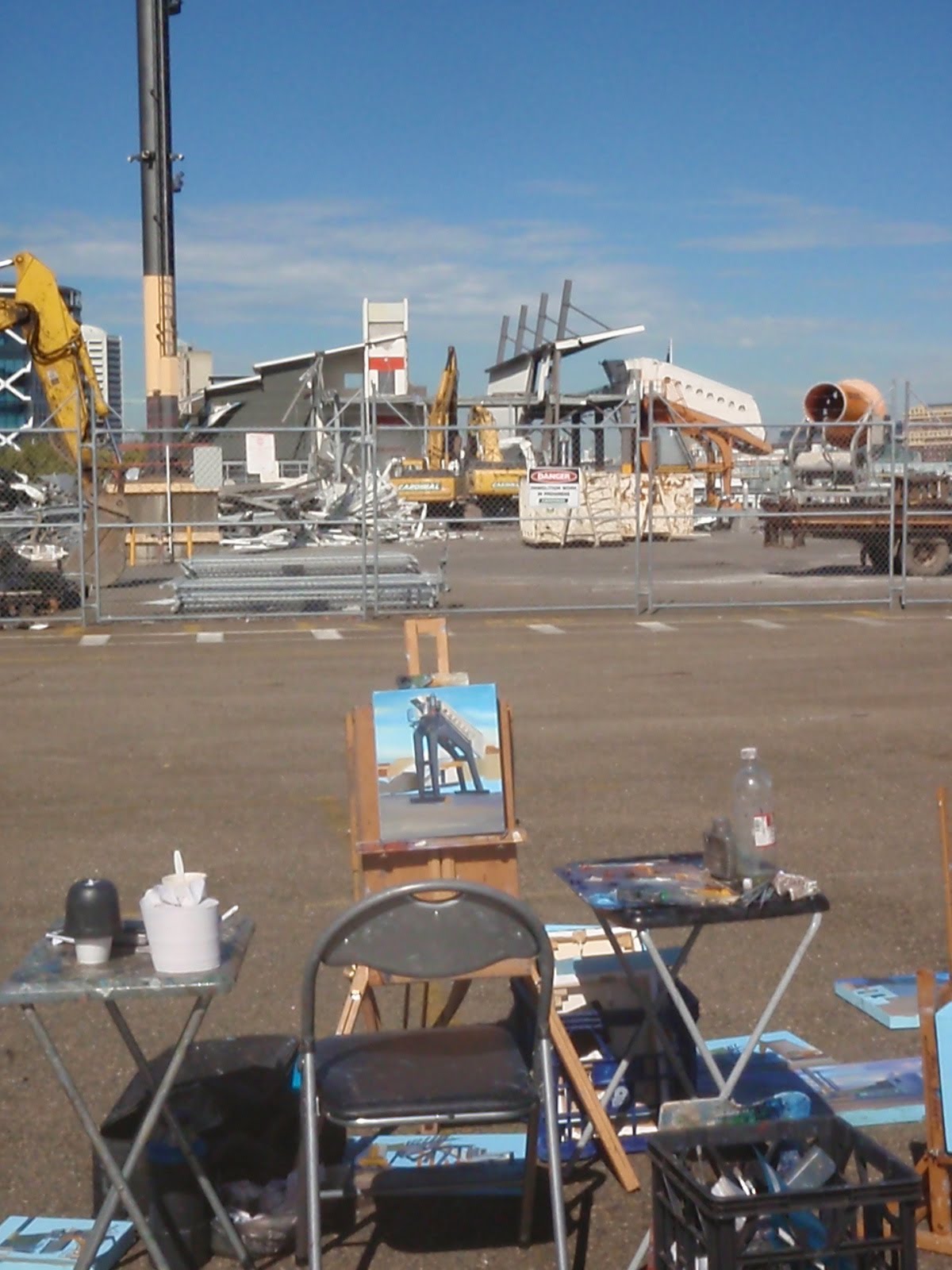
Starting a new large canvas- 8am on a cloudy windy day on the site of recently demolished Wharf 8 at South Barangaroo 

I have prepared a canvas suitable for the threatening clouds by priming it  with several coats of black acrylic paint. Canvases intended for either landscapes or seascapes I prime with either black or cerulean blue. This preparatory coat of coloured paint is known as the 'imprimatura', and I like to use it especially when painting outdoors rather than face the glare of a white canvas reflecting the sunlight back into my face. 
A black primed canvas is useful for storm clouds or interiors, while the blue canvases have the basic sky colour already laid in, so it is easier to add clouds, haze or mist at the horizon.

 8.30am
9.30am

9.30am
Note the scar of dark, new laid asphalt delineating the space where Wharf 8 used to be.

Gone with the Wind
10am


This canvas is fairly large for a plein air painting- 91 x 122cm. I intended it to be a continuation of the series of canvases from similar vantage points on this wharf of the same size which you can see on the right hand side of this blog, one painted when the 'Hungry Mile' was still a working port and the other a year later when the ships, trucks, containers, forklifts and wharfies had left. There are also other paintings of this size and format showing the demolition of the previous wharf buildings. I must say that the earlier paintings might have been more complex to paint, but this one is more physically difficult to manage, because now that most of the buildings have been demolished, there is no shelter from the wind on this wharf. 
That sounds like a minor gripe, but I have almost as much canvas up to catch the breeze as though I were windsurfing. The Philip's head screws on the struts of my french box easel, never a strong point of its design, are fighting a losing battle. I tighten them, but their little notches are almost worn smooth. The top of the easel with its canvas snaps back and forward unless I hold it steady with my left hand. It's tiring to paint like this and I dare not leave it long enough to eat my lunch, never mind about leaving it for a much needed toilet break. I'd be chasing my stuff all over the wharf. I try a useful trick with big canvases in a brisk wind - I change the angle so the canvas is side on to the wind, not catching it head on, and lower the angle so that the canvas is almost horizontal like a table top. A little like sailing, I should imagine, although I am by no means a sailor.
Last year I lost a much loved Akubra hat which blew off my head as I was packing up my things on my very last visit to paint the ferries the Balmain shipyard. I was so upset that I seriously thought about jumping into the Harbour and swimming after it, but I didn't want to be scuttled by the 'Lady Hopetoun'. I suppose some lucky New Zealander is wearing my lost Akubra  now. A good Akubra with a wide brim, not one of those silly pork pie jobs that don't keep the sun or rain off, is hard to find now. It will set you back about $150, and that doesn't include the toggles, which are almost impossible to buy. The shops only sell  Akubras for tourists these days and were amazed to hear of someone who actually needed to wear one for work. 'Did I also ride a horse at work' the assistants asked, wide-eyed with wonder. I had to disappoint them there. 
The wind is getting much worse. A good rule of thumb is that over 25 knots and the canvas starts to beat like a drum; the brushstrokes are timed to coincide. Annoying, but not insurmountable. Over 35 knots and a fully loaded french box easel starts to skitter around. Over 40 knots, and it will lift up and whack you on the nose if you don't tie it down. I have to move my car and cower behind it, using it as a wind break.
Painting clouds- 11am
Beware- Artist at work- 11.30am


If it weren't for the hard hat perched on top of it, the little black hat would look quite glam. It's no Akubra, though.
The smear of black paint on the cheek  really completes the look. 
Behind the canvas
I had to scavenge for this big concrete block to weight down my easel so I wouldn't have to chase it all over the wharf. The bricks are preventing the easel struts from being blown out of position and giving me a faceful of wet canvas. It only partly worked. I found out later the wind that day was over 45 knots. But despite the threatening clouds it didn't actually rain and I got a lot of painting done.

Sunday, October 17, 2010

Work Easy

Hand in Glove
'Work Easy'


I found this glove lying on the wharf. I noticed its reassuring gesture, but decided it was a subject worthy of being painted when I read its slogan "Work Easy". The combination of the battered trampled glove with the 'OK' gesture and the laid back 'Work Easy' slogan was too hard for me to resist.
Do the people who take the maxim "Work Easy" literally, make up for it by also "Playing Hard", I wonder? Or are they laid back in all aspects of their life?

One of my favourite quotes used to be "train hard, fight easy", which sounds as if it were a failed attempt at a Nike slogan or some of Muhammed Ali's pre-bout pugilistic poetry  , but I believe actually derives from von Clausewitz and probably sounds more formal in the original 19th century Prussian German dialect. This grim little aphorism is a reminder of the importance of early preparation for an important event, but "Work Easy" is its polar opposite. "Work Easy" sounds so humane, so relaxed, so cheerful and so reminiscent of how Australia used to be. An antidote to the barked commands of "Just do it" I can imagine the hapless owner of the lost glove failing to find it, saying "No worries"  and sloping off to the pub early.

'Work Easy'2010 oil on canvas 20 x 20 cm

Enhanced by Zemanta

Monday, October 11, 2010

Walking with Industrial Dinosaurs at Barangaroo

The "Pulverizer" in action.
'The Pulverizer and the Watertank' 2010 oil on canvas 15 x 30cm
This painting shows the aptly named "Pulverizer" doing just that. Its target is the base of one of the recently demolished power and light poles; another of these is in the foreground.

The Hungry Excavators

The excavators lumber around the site like a pack of marauding dinosaurs. The largest excavator of the site, the Sumitomo 800, resembles the top predator  T. rex, as usually it wears a heavy jawed attachment that seems too top heavy for its body. The  excavators seem to lie in wait, either hibernating for the winter or digesting their meal. Then they stir from their slumber, shake themselves and stretch and circle around, looking for a weak spot to target. They seem to wander around aimlessly, but you know they are just biding their time, choosing a suitable victim. When they strike it is sudden and merciless. There is a struggle as the heavy jaws clamp and pull. They tear and twist scraps from the target. Sometimes they take a breather to chew their cud. Other lesser beasts hang around the edges scavenging the leftovers, as they wait for the noble beast to finish its kill.
I think I've been watching too many Attenborough documentaries.

The Archaeologists at Barangaroo

A new trench
'Digger (The Trench)'  2010 oil on canvas 30 x 15 cm
The site archaeologists of South Barangaroo are Casey & Lowe. Here they have briefly stopped work to consult as the excavators have unearthed a pipe. Possibly Barangaroo isn't one of the most fascinating archaeological sites as it is mostly fill, and fill dating probably no earlier than the 1960's. But breaking the surface to dig a new hole is always exciting, even if there is no prospect of buried treasure or even broken bottles or blue and white pottery fragments at the end of it!

Dig it!
'Dig it' 2010 oil on canvas 20 x 20 cm

The archaeologists have discovered some timber, possibly from a 19th century Fingerwharf, and some paving stones. Some paving stones can be seen in the right foreground; fragments of timber are in the centre foreground, in the midground in front of the shovels, and to the far left.

Saturday, September 18, 2010

The Art of Painting in PPE (Personal Protective Equipment)

Gone in 60 seconds
Yesterday they started to pulverize the power poles. I can't sit where I have been for the last week and finish my diptych, which was going to be a panorama of the whole site. When they have finished I can return to the spot, however the blocks which were to have been the whole key of the composition will be gone.
On the other hand, Andrew, the site foreman, has assured me that the big red statue of the number "8", to which I have taken quite a fancy, won't be demolished for at least a week.
 Hear no evil (or anything else)
I had to use hearing protection to cope with the noise. The hearing protection on this site is a rather snazzy set of fluoro orange earbuds attached to a headset rather than the usual rolled up bits of pink and  orange foam. However the headset is way too big for the back of my head and I got it in a dreadful tangle with my hard hat balanced precariously on top of my cap with its sun-veil at the back, my scarf and safety glasses and my Bovis LendLease lanyard with my site passport. As usual the photo on my ID gives me the expression of an escaped lunatic who has just been shot in the back with a poisoned arrow. So does everyone else's; I'm glad mine doesn't stand out. Would the headset be less uncomfortable up over my hard hat or flapping down around my shoulders? Neither of these positions worked so I finally clamped it over my sunveil; not the most hygienic solution but at least it stopped drilling painfully into my ears. Today I gave up on these ear-drillers and brought my enormous old ear muffs out of retirement. They certainly dull the noise but wearing them is like having a pair of buckets stuck either side of my head. When someone speaks to me I have to clamp them to the top of my hard hat, in a way that reminds me slightly of Mickey Mouse ears. With all this heavy duty ear protection, I don't know why my ears still stick out at right angles like Tony Abbot's, they should be squashed so flat by now that I'm wearing them internally.
My cap does prevent most of my face and ears from getting sunburnt, and has a useful little gap at the back for my ponytail  but unfortunately it has the words "Frontline" written in bold yellow capitals at the front. This is not as you might think in honour of the famous dog and cat flea killing powder- this word is also the motto of Australian Customs and Quarantine; this cap was a souvenir of painting a commission for someone who worked for them when Barangaroo was still a working port.
I am still clumsy when attaching or removing my flashing orange beacon to or from the car. I keep forgetting it's there and open the car door suddenly, or drive off site with it still flashing merrily away.
In the afternoon it gets very dusty as the wind direction changes from westerly to a nor-easter. They hose down the dust as much as possible, but I am now wearing a face mask as an extra precaution. It's not specifically required, but I think that it would be sensible. However I feel so trussed up that I can barely move and resemble a badly decorated Xmas tree.

Fast work
I have completed 2 small canvases yesterday and another 2 today. Not bad going! Yesterday, the first was of the pulverizing of the power poles. I was told not to bother as there would only be 2 hours or so before I would have to move, as the excavator would soon start on the second block. I had just enough time to paint a 15 x 30 cm canvas. The second was a small square painting of a "Grabber", one of the attachments for the excavators. Today I painted a "Muncher" to match the "Grabber" on the same format canvas, and the green waterpump draining the giant pool of water caused by the hosing down of the dust.

Wednesday, September 15, 2010

Eight (ate)

Barangaroo : Demolition of Wharf 8

"Eight (ate)" 2010 unfinsihed oil painting on canvas 31 x 25 cm
The Wharf building is now demolished. All that remains is a pile of twisted metal, and the giant red numeral.
The forked sign painted at the foot of the 8 is actually really there, but to me it symbolizes the whole dilemma of Barangaroo, of Sydney and possibly of Australia itself. Caught between two possible directions (remember the election anybody?) equally poised between looking back and moving forward. Progress and change are needed, but in which direction?
Update on eight (ate)

'Eight (ate)' 2010  oil painting on canvas 31 x 25 cm


The finished painting.

Monday, September 13, 2010

Geophysics

The Drill Rig at South Barangaroo
"The Drill rig" 2010 oil painting on canvas 30 x 40cm
A core sample is being taken on South Barangaroo, to make sure that there are no nasty little surprises when construction starts.

Incidentally, all of Barangaroo is landfill.
When I painted on the K.E.N.S. Site (the "Kent, Erskine, Napoleon and Sussex street block " which is now the new Westpac headquarters) next to Moreton's pub (known as the 'Big House' by the wharfies) I saw steps that were unearthed that once belonged to an early 19th century Fingerwharf, and must have roughly coincided with the original shoreline. They were halfway between Kent and Sussex Street - so anything west of Sussex Street is fill.


Don't forget your toothpaste! (A little amateur archaeology)

A couple of the men from Coffey and Macquarie Drilling have worked at the same sites that I have painted at! These include the former A.G.L. Site at Mortlake, developed by Rosecorp (which is now known as 'Breakfast Point') and the Carleton United Brewery site at Chippendale, which is still underway. One wet and miserable day at the Carleton United Brewery site, I was offered some of the old bottles and jars to paint by the archaeologists, instead of struggling through the mud laden with an easel to paint the chimney in the pouring rain. A few weeks later, the archaeologists generously made their spare finds available for the construction workers to souvenir. I suppose that an old brewery site wouldn't suffer from a lack of bottles! I took a small selection of 19th century ceramic and glass bottles, including perfume jars, ink bottles and a big brown 'Geneva' bottle (mother's ruin or gin), but one of the men on the drill rig team had a real prize - a small ceramic jar with lacy craquelure that once contained an early 19th century version of toothpaste! When we realized that we both were proud owners of these relics, I brought my paintings of the CUB finds and the bottles to Barangaroo and he brought in his toothpaste jar for me to paint.
My Carleton United Brewery still life can be seen on my 'Urban Landscape' page on my other blog, 'Industrial Revelation'.
This is their 2nd last hole before the drill rig team pack up and leave Barangaroo.

Tuesday, September 7, 2010

Barangaroo : Terminal- Demolition

The demolition of Wharf 8
'Collapse' oil painting on canvas 36 x 46 cm
There isn't much left of the main building now, and this morning the last gantry was demolished about 10am.
Ironically it was taken down by the very same man who built the other gantry, (the orange one that stood closest to King Street Wharf) only 8 years ago.
I've been torn between wanting to paint the spectacular collapse of the main Arrivals Hall to the south, from the vantage point of the giant statue of the number '8' and the pulling down of the gantries about 300 metres walk from this.
Previously, I could leave my easel in a corner of one of Cardinal's sheds, but today they have started to move all their tables,chairs and equipment out in preparation for the move to the sheds being completed at the north-western end of the compound. So it looks like several long walks back to my car dragging lots of heavy equipment.

Sunday, September 5, 2010

The first cut is the deepest

Barangaroo :  Demolition starts of former Cruise ship Terminal at Darling Harbour Wharf 8
'The '800' demolishing the Gantries' 2010 oil painting on canvas 36 x 46 cm
The Gantries

'The Gantries' Unfinished oil painting on canvas 36 x 46cm
Breakfast in the ruins
Gantry
'Gantry (keep)' Almost finished oil painting on canvas 46 x 36 cm
I had wondered if the gantries were to be kept intact & possibly recycled for use at the new cruise ship terminal soon to be built at White Bay.
They are instead about to be demolished by the very same man who built the orange gantry only 8 years ago.
The MUA has just linked an article about my paintings of the Hungry Mile & Barangaroo on their website to my other blog, "Industrial Revelation".

Barangaroo : Terminal - Facade

A last look at Wharf 8, the former Cruise Ship Terminal

'Wharf 8- facade with red door' 2010 Unfinished oil on canvas 31 x 61 cm.

'The Red Door closes' unfinished oil painting on canvas 25 x 51 cm

Barangaroo : Terminal -The Artist's Studio

My Studio at Barangaroo : Works in progress


Painting inside the the former Cruise ship Terminal at Darling Harbour 8 painted in July-August 2010. 

"Red Square"


A race against time

I make the big move out of the terminal


"Grabber,Muncher, Ripper,"
"Grabber, ripper,muncher" 2010 oil painting on canvas 31 x 31cm
Yes, they actually are the proper names of the attachments to the excavators! I'm not making them up. Truly.
The "Grabber" is in the centre, the "Ripper" is the wicked looking blade on the right, while the "Muncher" is the monster with the fluoro pink "eye" & the toothy jaws in front of the red door to the left. The workmen promised me that there is also a "Pulverizer" that will arrive later. This I have to see!
A good day at the office
The very last day that I was able to leave my easels and canvases inside the terminal. I've now moved my stuff into a room in the loading dock of the old Sydney Ports Corporation Maintenance building that has been recently used to display the designs for Barangaroo. Not for long, apparently - Bovis LendLease has already moved the entrance twice and I've noticed construction of new site offices starting in the north-west corner. This building will obviously be the next to go after the DH8 terminal. Exactly when is anyone's guess.

Barangaroo : 'Grabber, Ripper, Muncher'

Barangaroo : 'Grabber, Ripper, Muncher'
'Grabber, Ripper, Muncher'  2010 oil painting on canvas 31 x 31 cm

As well as "Grabber", "Muncher" and "Ripper" I have learnt some more evocative & descriptive terms for the attachments to excavators. "What are those bucket-like things on the end of them?" I tentatively asked. "Buckets" was the reply. I must be getting the hang of it now. The buckets with teeth are called "toothed buckets" and the blunt ones are called "mud buckets". Sheer poetry.

Barangaroo : Terminal- 'Out of Time'

Inside the former cruise ship terminal at Wharf 8, Barangaroo

The completed painting "Out of time " unfinished oil painting on canvas 31 x 31 cm
A poignant little genre painting. Stopped clocks; a security sign; an abandoned storeroom. Industrial memento mori. I found a plaque commemorating the opening of this building - 1999. Not all that long ago, but already it seems like an eon has passed.
Sydney Ports Corporation has just arrived to take possession of this sign. I found it's inscription hilarious - it was about how passengers with cardiac pacemakers were not to go through the X ray machines, but had to be bodily searched by the security guards! if they didn't have heart problems to start with they would when they finished; all the excitement might prove too much!